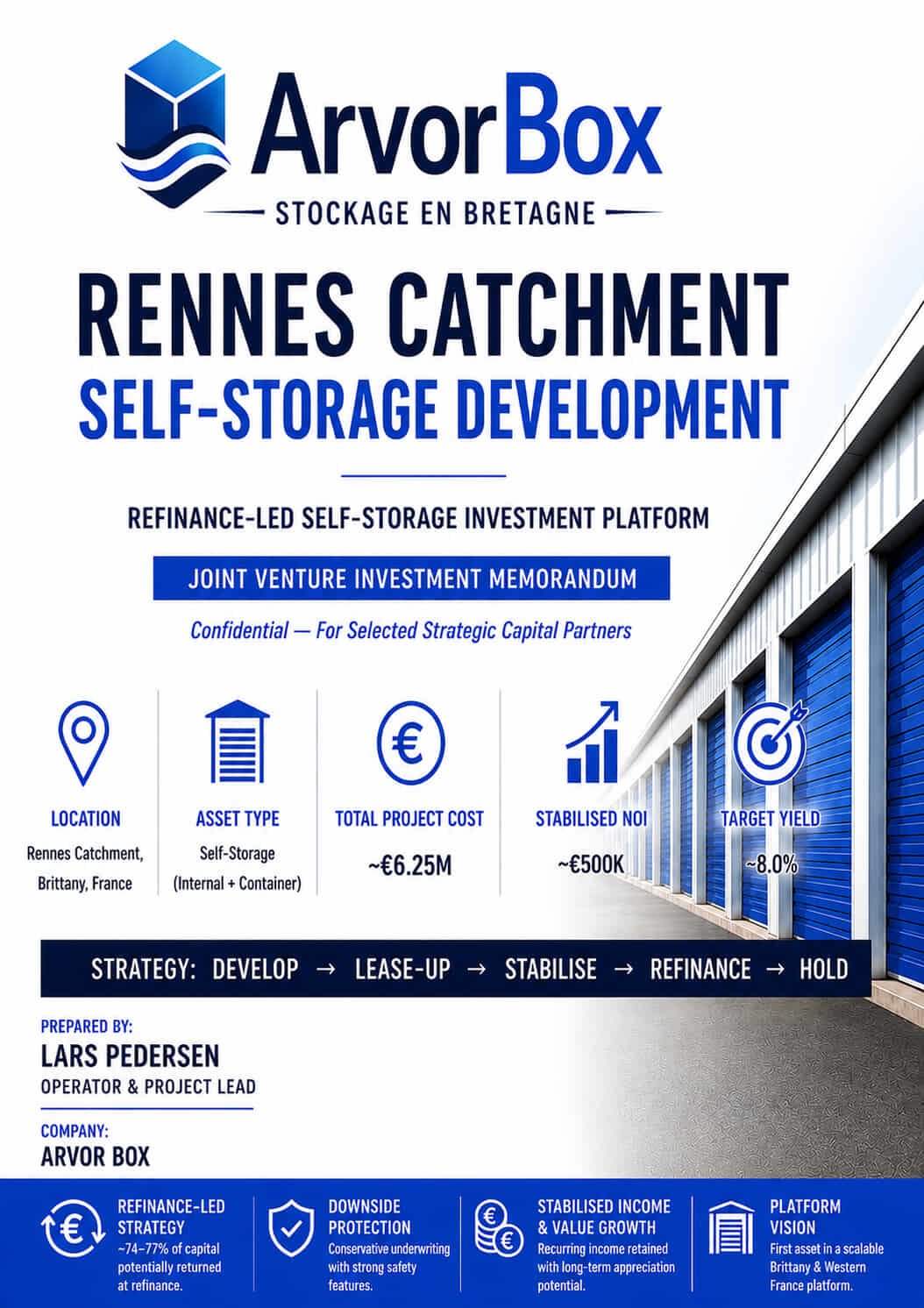
Executive Summary
Investment Thesis
ARVOR BOX is a refinance-led self-storage investment platform targeting structurally undersupplied secondary markets in western France.
The first asset, located within the Rennes economic catchment in Brittany, combines conservative development execution, operationally driven value creation, and early capital recovery through stabilisation and refinance.
The Project has been intentionally structured around:
- capital protection
- execution discipline
- operational scalability
- conservative underwriting
- refinance-led capital recycling
Unlike speculative development projects dependent on exit timing, ARVOR BOX is designed as a long-term income-producing real asset platform capable of scalable regional expansion.
Investment Highlights
Metric | Summary |
Total Project Cost | €6,252,500 |
Internal Net Lettable Area | 3,297 m² |
Internal Units | 499 |
External Storage Area | ~4,000 m² |
Development Structure | Refurbishment-Led |
Funding Structure | 100% Equity Funded |
Development Debt | None |
Stabilisation Timeline | 24–36 Months |
Target Stabilised Yield | ~8.0% |
Target IRR | ~12–13% |
Target Refinance Proceeds | €4.6M–€4.8M |
Market Positioning | Undersupplied Secondary Market |
Core Investment Logic
The Project’s value creation strategy is intentionally straightforward:
- Acquire and develop the asset
- Lease-up over 24–36 months
- Stabilise NOI
- Refinance against stabilised income
- Return substantial investor capital (Approximately 74–77% of total project capital is potentially recoverable through refinance based on current underwriting assumptions.)
- Retain ownership of income-producing asset
The investment therefore combines:
- downside-protected structure
- recurring operational income
- capital recovery via refinance
- long-term portfolio optionality
Strategic Positioning
ARVOR BOX is not positioned as a standalone speculative development.
The Project represents the first asset within a broader Brittany-focused storage platform strategy targeting:
- operational scalability
- portfolio aggregation
- capital recycling
- long-term institutional positioning
The long-term objective is the development of 4–5 facilities across the region over a 10–15-year period.
Investment Highlights
Investor-Oriented Structure
The Project has been structured specifically to align investor protection with operational execution.
Key structural strengths include:
- no development debt
- conservative refinance assumptions
- investor-first waterfall
- asset-backed downside protection
- phased expansion capability
- flexible refinance timing
Refinance-Led Capital Recovery
Unlike traditional development projects reliant on exit, the Project prioritises:
operational stabilisation and refinance-based capital recovery.
At stabilisation:
- debt introduced only after income stabilisation
- target LTV ~60%
- estimated refinance proceeds €4.6M–€4.8M
- substantial investor capital returned
This significantly reduces residual equity exposure while retaining ownership of a stabilised income-producing asset.
Market Positioning
The Project targets a structurally undersupplied regional market characterised by:
- fragmented storage supply
- low institutional penetration
- strong SME density
- increasing residential mobility
- limited modern facilities
This positioning allows:
- attractive yield-on-cost economics
- reduced institutional competition
- operational pricing flexibility
- scalable regional expansion potential
Strategic Positioning
ARVOR BOX has been intentionally structured as:
a refinance-led regional real-asset platform.
The Project is not dependent on:
- speculative appreciation
- rapid resale
- aggressive leverage
- institutional debt during development
Instead, value creation is driven through:
- disciplined execution
- operational lease-up
- NOI stabilisation
- long-term income generation
The platform strategy allows:
- repeatable development
- operational consistency
- scalable portfolio construction
- enhanced long-term exit optionality
Why This Opportunity Exists
French Market Undersupply
The French self-storage market remains materially underpenetrated relative to the UK and US markets.
Outside major metropolitan areas, supply remains fragmented and often operationally outdated.
Within Brittany and the wider Rennes catchment:
- modern self-storage provision remains limited
- institutional operators remain concentrated in major urban centres
- secondary markets remain underserved
Structural Demand Drivers
Demand growth is supported by:
Residential Drivers
- downsizing
- relocation
- urban density pressure
- temporary storage demand
SME & Trade Drivers
- flexible storage needs
- equipment and inventory storage
- avoidance of long commercial leases
- contractor and trades demand
E-Commerce & Logistics Drivers
- small-scale fulfilment activity
- inventory management
- regional logistics support
These structural trends support long-term demand growth beyond cyclical real estate conditions.
Investment Structure
Capital Structure
The Project is funded on a fully equity-funded basis at entry.
Key Principles
- no development debt
- no covenant exposure during construction
- no lender pressure during lease-up
- full execution flexibility
Debt is introduced only after stabilisation and proven operational performance.
Equity Participation
Participant | Role |
Investor | 80–85% Equity Participation |
Operator | Minority Equity Participation |
Developer | Contractor Only – No Equity |
The Operator’s equity participation ensures direct alignment with:
- delivery
- operational performance
- stabilisation
- long-term asset value creation
Investor-First Distribution Waterfall
Distributions are structured as follows:
- Return of investor capital
- Preferred return (~8%)
- Profit participation pro rata
This ensures:
- priority investor protection
- alignment of incentives
- performance-based operator participation
Investor Safety Features
The structure has been designed specifically around downside protection.
No Development Debt
The absence of development leverage removes:
- refinancing risk during construction
- covenant pressure
- lender execution dependency
- forced asset sale exposure
Conservative Underwriting
The model assumes:
- gradual lease-up
- conservative occupancy ramp
- realistic local pricing
- fully loaded French cost structure
Flexible Refinance Timing
Refinance is optional, not mandatory.
If market conditions are temporarily unfavourable:
- the asset can continue operating
- refinance can be delayed
- recurring income remains intact
Income-Producing Hold Viability
Even under downside scenarios, the asset remains:
- operationally viable
- income generating
- asset-backed
This significantly reduces downside exposure relative to speculative development models.
Project Overview
Core Asset
The Project involves the refurbishment and conversion of an existing warehouse into a modern self-storage facility.
Internal Facility
Specification | Detail |
Net Lettable Area | 3,297 m² |
Total Units | 499 |
Unit Mix | Small / Medium / Large |
Pricing Assumption | ~€21/m²/month |
The internal units form the primary underwriting basis for the investment.
External Expansion Capability
The site additionally includes approximately 4,000 m² of external container storage area.
This component is targeted toward:
- tradespeople
- SMEs
- contractors
- equipment storage users
Container deployment is phased according to demand and is not required to support the base underwriting assumptions.
Operational Infrastructure
The facility is designed around modern operational efficiency and security.
Security Features
- full perimeter fencing
- controlled access gates
- CCTV system
- perimeter lighting
- intrusion systems
Operational Systems
- access control
- flexible pricing capability
- scalable management systems
- operational monitoring
The operating structure supports:
- lean staffing
- high operating margins
- scalable operational performance
Location & Demand
Rennes Economic Catchment
Rennes is one of western France’s strongest regional economic centres.
The wider catchment benefits from:
- population growth
- strong SME density
- regional economic activity
- logistics connectivity
- residential mobility
Secondary Market Strategy
The Project deliberately targets a secondary catchment rather than a saturated prime urban core.
This strategy provides:
- lower acquisition basis
- stronger yield-on-cost economics
- reduced institutional competition
- pricing flexibility
- improved long-term operational margins
Demand Diversification
The Project benefits from diversified demand sources:
Residential Demand
- moving and relocation
- downsizing
- temporary storage
- urban space limitations
Commercial Demand
- tradespeople
- contractors
- SMEs
- e-commerce operators
- equipment and inventory storage
This diversification reduces reliance on any single customer segment.
PROJECT TIMELINE & DELIVERY ROADMAP
Indicative Delivery Timeline
Phase | Timeline |
Investor Alignment & JV Structuring | Immediate |
Transaction Negotiation & Acquisition Completion | Subject to Investor Alignment |
Development Mobilisation | Months 1–3 |
Design Finalisation & Procurement | Months 3–6 |
Construction & Infrastructure Works | Months 6–18 |
Operational Platform Deployment | Months 6–21 |
Facility Commissioning & Launch Preparation | Months 18–21 |
Operational Launch | Month 21 |
Lease-Up Phase | Months 21–57 |
Stabilised Occupancy Target (85–90%) | Months 45–57 |
Refinance Evaluation Window | Months 48–60 |
Current Transaction Position
The Project was previously secured under an exclusivity arrangement which concluded on 28 May 2025.
The exclusivity period enabled substantial advancement of:
- Project planning
- Development strategy
- Capital structuring
- Operational platform design
- Investor engagement
The Project remains available for engagement with aligned strategic investors and operator-partners capable of supporting acquisition, development and long-term platform growth.
Execution Sequence
The Project follows a deliberately simplified execution structure designed to reduce:
- delivery complexity
- financing dependency
- operational fragmentation
- timeline exposure
The execution model follows:
Acquisition → Refurbishment → Operational Launch → Lease-Up → Stabilisation → Refinance
This sequence has been intentionally structured around:
- controlled capital deployment
- operational accountability
- accelerated income generation
- refinance-led capital recovery
INVESTOR RIGHTS & PROTECTION SUMMARY
Investor Right | Structure |
Asset-Level Ownership | ~80–85% SPV Equity |
Asset Ring-Fencing | Yes |
Preferred Return | ~8% |
Refinance Participation | Yes |
Priority Capital Return | Yes |
Reserved Matters Protection | Yes |
Governance Rights | Defined In SHA |
Reporting Structure | Regular Operational & Financial Reporting |
New Debt Approval | Investor Consent Required |
Major Asset Decisions | Investor Approval Required |
Investor Protection Philosophy
The governance structure has been intentionally designed to ensure that:
- investor capital remains asset-backed
- major strategic decisions remain protected
- operational execution remains efficient
- future platform growth does not dilute SPV ownership
The structure therefore balances:
- operational agility
- investor oversight
- scalable platform expansion
- long-term alignment
WHY ARVOR BOX CAN EXECUTE
Operator-Led Execution Model
ARVOR BOX is structured as an execution-focused operating platform rather than a passive development vehicle.
The Project is led directly by Lars Pedersen through:
- active project mobilisation
- direct operational oversight
- lease-up responsibility
- pricing and occupancy management
- contractor coordination
- systems implementation
- operational performance management
Execution-Focused Structure
The operating structure has been intentionally designed to:
- centralise operational accountability
- preserve execution speed
- minimise decision fragmentation
- maintain direct operator involvement throughout stabilisation
Unlike sponsor structures dependent upon external operators or fragmented management, ARVOR BOX maintains direct operational control throughout:
- development
- launch
- lease-up
- stabilisation
Practical Commercial Positioning
The Project is positioned around:
- disciplined execution
- conservative underwriting
- operational scalability
- income-driven value creation
The focus is intentionally commercial rather than speculative.
The objective is not rapid resale or aggressive leverage, but the creation of:
a scalable, income-producing real asset platform capable of long-term regional expansion.
Long-Term Alignment
The Operator’s long-term economic participation is dependent primarily upon:
- successful execution
- occupancy growth
- NOI stabilisation
- refinance achievement
- future platform performance
This creates direct alignment between:
- investor outcomes
- operational execution
- long-term value creation
Market Validation & Competitive Positioning
Market Characteristics
The local market remains characterised by:
- fragmented supply
- limited purpose-built modern facilities
- operationally outdated competitors
- absence of dominant institutional operators
This creates a favourable environment for:
- rapid market positioning
- operational differentiation
- long-term occupancy growth
Pricing Validation
Regional benchmarking indicates:
Product | Market Range |
Internal Storage | €18–€24/m²/month |
ARVOR BOX Assumption | ~€21/m²/month |
The underwriting therefore remains:
- market aligned
- operationally achievable
- conservatively positioned
Competitive Advantage
The Project differentiates itself through:
- modern facility quality
- operational scalability
- flexible unit mix
- external storage capability
- security standards
- SME-focused accessibility
Site Evidence & Market Validation
1. Catchment Evidence
The Rennes catchment provides a strong demographic and economic base for a modern self-storage facility. Rennes city recorded 227,830 inhabitants in 2022, while Rennes Métropole recorded 473,973 inhabitants, with Rennes Métropole growing at an average annual rate of 1.1% between 2016 and 2022.
This supports the project’s residential demand thesis through moving, downsizing, household overflow, renovation, student mobility and temporary storage needs.
2. SME & Business Demand
Rennes Métropole also demonstrates a substantial business base. Public SIRENE/INSEE-linked data identifies enterprise and establishment records across Rennes Métropole, while local economic datasets show a broad commercial base across services, construction, trade, logistics and related activity.
This supports demand from:
- SMEs
- tradespeople
- contractors
- e-commerce users
- equipment storage users
- archive storage users
- regional service businesses
This is strategically important because ARVOR BOX is not dependent purely on residential storage demand.
3. Existing Competitor Evidence
The Rennes market is not empty, but it remains fragmented. Current identified market participants and storage alternatives include:
- Stocker Seul Rennes, located at 12 quai Robinot de Saint-Cyr, Rennes.
- Locakase Rennes, offering secured storage boxes from 1m² to 50m² with flexible duration.
- Annexx, which states it is opening a new storage facility in Rennes.
- Selfstock facilities serving the wider Ille-et-Vilaine / Brittany region, including locations outside Rennes.
- Storabble identifies 12 storage solutions near Rennes, including self-storage, storage rooms, garages and other storage formats.
This confirms market existence while also showing fragmentation rather than dominance by a single institutional operator.
4. Pricing Evidence
Current local and regional pricing evidence supports the ARVOR BOX underwriting assumption of approximately €21/m²/month.
Selfstock shows storage pricing in the wider Rennes / Brittany region starting from approximately €69/month for boxes of 3–14m² in nearby markets.
French self-storage pricing benchmarks indicate smaller units can range from approximately €15–€25/m²/month, with larger units priced lower per m², supporting the use of a blended average assumption.
The ARVOR BOX pricing assumption of ~€21/m²/month therefore sits within a credible market-supported range.
5. Drive-Time Catchment Logic
Because the exact site location is not being disclosed at first-stage memorandum level, the drive-time analysis should be presented directionally rather than with a pin-pointed address.
The investment logic assumes a practical catchment based on:
- 10–15 minute local access for residential and SME users
- 20–30 minute regional access for trade, contractor and business users
- wider Brittany accessibility for external container and commercial storage demand
This is appropriate for a self-storage asset positioned around both residential and commercial users.
6. Market Validation Summary
The evidence supports the core ARVOR BOX thesis:
Rennes has a large and growing population base, a substantial SME and business ecosystem, existing self-storage demand, fragmented competitor provision, and pricing evidence broadly aligned with the project’s underwriting assumptions.
The market is therefore not speculative. It is an existing but still underdeveloped regional self-storage market with room for a professionally positioned, operator-led facility.
Why Self-Storage
Self-storage remains one of the strongest-performing alternative real estate sectors globally due to:
- recurring monthly income
- fragmented customer bases
- inflation-adjustable pricing
- defensive demand characteristics
- low operational overhead
- operational scalability
The sector additionally benefits from:
- short-term customer agreements
- flexible pricing capability
- relatively resilient occupancy trends
These characteristics create a stable income-oriented operating profile.
Why Now
Several structural trends support current market timing.
Rising French Market Adoption
Self-storage adoption in France continues to expand as consumer and SME behaviour evolves.
Secondary Market Supply Gaps
Institutional development remains concentrated primarily within major urban centres.
Secondary catchments therefore continue to offer:
- stronger yield spreads
- reduced competition
- lower entry cost
SME Flexibility Demand
Businesses increasingly require:
- flexible storage
- short-term commitments
- operationally efficient space
This directly supports the Project’s positioning.
Alternative Real Asset Demand
Investors continue increasing allocation toward:
- operational real estate
- defensive income assets
- scalable alternative sectors
Self-storage continues benefiting from this trend.
Development Strategy
Refurbishment-Led Execution
The Project follows a refurbishment-led development strategy designed to minimise:
- planning complexity
- construction risk
- timeline exposure
- capital intensity
This allows:
- faster operational launch
- lower development risk
- controlled capital deployment
Development Scope
Works include:
- warehouse conversion
- unit fit-out
- access systems
- insulation upgrades
- external preparation works
- security systems
- operational infrastructure
Delivery Model
Developer
The developer acts solely as:
- asset seller
- construction contractor
The developer:
- receives fixed margin compensation
- holds no equity
- has no operational role post-completion
Operator
The Operator is responsible for:
- on-site oversight
- coordination of fit-out
- operational mobilisation
- lease-up execution
- pricing strategy
- ongoing operational performance
This creates:
- accountability
- operational continuity
- aligned execution incentives
Development Cost & Capital Structure
Total Project Cost
Cost Category | Amount |
Land Acquisition | €2,000,000 |
Construction & Refurbishment | €1,070,000 |
Professional Fees | €145,000 |
Development Costs | €595,000 |
Fit-Out | €690,000 |
Equipment & Security Systems | €325,000 |
Containers – Phase 1 | €100,000 |
Agency Fees | €200,000 |
Notary Fees | €297,500 |
Cashflow Reserve | €270,000 |
Operational Platform Establishment | €120,000 |
Developer Margin | €440,000 |
Total Project Cost | €6,252,500 |
Financial Discipline
The Project structure prioritises:
- transparent capital deployment
- strict cost control
- operational oversight
- disciplined execution
The absence of development debt materially simplifies project execution.
Financial Model
Lease-Up Profile
Year | Occupancy |
Year 1 | ~45% |
Year 2 | ~70% |
Year 3 | ~85–90% |
The lease-up assumptions reflect:
- controlled market penetration
- pricing optimisation over time
- realistic demand absorption
Revenue Profile
Revenue Stream | Stabilised Revenue |
Internal Storage | €700K–€760K |
Container Storage | €100K–€130K |
Total Revenue | €800K–€860K |
The underwriting is based primarily on the internal storage component.
Container storage provides supplementary upside.
Operating Costs
The operating model incorporates:
- staffing
- employer social charges
- utilities
- insurance
- administration
- maintenance
- security systems
Operating Cost Ratio:
~35–40%
NOI Profile
Projected stabilised NOI:
~€480K–€520K annually
This supports:
- stable recurring income
- refinance capability
- long-term asset value growth
Valuation Framework
Metric | Assumption |
Stabilised NOI | €480K–€520K |
Market Yield | ~6.5% |
Implied Asset Value | ~€7.7M–€8.0M |
The assumptions remain conservative relative to stabilised operational performance.
Lease-Up Validation & Occupancy Strategy
Occupancy Assumptions
The financial model assumes a gradual and operationally disciplined lease-up profile:
Year | Target Occupancy |
Year 1 | ~45% |
Year 2 | ~70% |
Year 3 | ~85–90% |
These assumptions are not based upon aggressive market capture expectations but rather on a combination of market evidence, operational strategy, pricing flexibility and diversified demand drivers.
Why The Occupancy Assumptions Are Considered Achievable
The ARVOR BOX lease-up strategy has been structured around proven self-storage operating principles rather than speculative growth assumptions.
The Project benefits from four key drivers:
• Existing market demand
• Undersupplied regional positioning
• Diversified customer acquisition
• Active revenue management
Together these factors support the projected occupancy trajectory.
Market Demand Validation
The Rennes catchment represents one of the strongest regional economic centres in western France, serving both residential and commercial demand.
Demand is expected to originate from:
Residential Customers
• Moving and relocation
• Downsizing
• Property renovation
• Student and temporary accommodation transitions
• Household overflow storage
Commercial Customers
• Tradespeople
• Contractors
• SMEs
• E-commerce businesses
• Inventory storage users
• Equipment and archive storage customers
The Project therefore benefits from multiple independent demand sources rather than reliance on a single customer segment.
Competitive Positioning
Although self-storage facilities exist within the wider Rennes market, supply remains fragmented and varies significantly in age, quality, accessibility and operational sophistication.
ARVOR BOX is designed to differentiate itself through:
• Modern facility presentation
• Flexible unit mix
• Strong security standards
• External storage capability
• Professional revenue management
• SME-focused accessibility
The inclusion of approximately 4,000 m² of external storage provides an additional customer segment not always served by traditional self-storage facilities.
This broadens the addressable market and supports occupancy growth.
Marketing Strategy
The lease-up model assumes active operational management from launch rather than passive customer acquisition.
Customer acquisition channels are expected to include:
Digital Marketing
• Google Search
• Google Maps
• Local SEO
• Paid Search Campaigns
• Online Directory Placement
Local Commercial Outreach
• Tradespeople
• Construction businesses
• Local SMEs
• Logistics operators
• Estate agents
• Relocation services
Partnership Marketing
• Removal companies
• Property professionals
• Housing service providers
• Business networks
This diversified marketing strategy reduces dependence on any single lead source and supports consistent occupancy growth.
Pricing Strategy
The underwriting assumes an average achieved rental rate of approximately €21/m²/month.
The pricing model incorporates active revenue management rather than fixed pricing.
Early Lease-Up Phase
During initial occupancy growth:
• Promotional incentives may be utilised selectively
• Introductory pricing may be offered on specific unit types
• Marketing campaigns may support rapid market penetration
Stabilisation Phase
As occupancy increases:
• Pricing is progressively optimised
• Promotional dependency reduces
• Revenue per occupied square metre increases
This approach mirrors established self-storage operating practices and supports both occupancy growth and long-term NOI optimisation.
Operational Focus
The ARVOR BOX model is based on the principle that self-storage is fundamentally an operational business rather than a passive real estate investment.
Occupancy performance is expected to be driven through:
• Active customer acquisition
• Dynamic pricing management
• Customer retention initiatives
• Operational responsiveness
• Direct operator oversight
The Operator remains directly responsible for lease-up execution, occupancy growth and revenue optimisation throughout the stabilisation period.
Conclusion
The occupancy assumptions of approximately 45% in Year 1, 70% in Year 2 and 85–90% by Year 3 are considered achievable due to:
• Existing market demand within the Rennes catchment
• Diversified residential and SME customer bases
• Competitive facility positioning
• Active marketing strategy
• Flexible revenue management
• Direct operator-led execution
The assumptions are intentionally structured as realistic operational targets rather than aggressive growth projections and remain consistent with the Project's conservative underwriting philosophy.
NOI Validation & Operating Income Bridge
Purpose
The financial model assumes a stabilised Net Operating Income (NOI) of approximately €500,000 per annum.
This section provides a simplified operating bridge illustrating how the projected NOI is derived and demonstrates that the underwriting remains grounded in realistic occupancy, pricing and operating cost assumptions.
Stabilised Operating Assumptions
Internal Net Lettable Area:
3,297 m²
Target Stabilised Occupancy:
85–90%
Average Achieved Occupancy Assumption:
87.5%
Average Rental Rate:
~€21/m²/month
External Storage Area:
~4,000 m²
Revenue projections are intentionally conservative and reflect achievable market pricing within the Rennes catchment.
Revenue Bridge
Internal Self-Storage Revenue
3,297 m² × 87.5% occupancy × €21/m²/month × 12 months
= Approximately €727,000 per annum
External Container Storage Revenue
The external storage component provides additional income potential from:
• Tradespeople
• Contractors
• SMEs
• Equipment storage users
Stabilised external storage revenue assumption:
≈ €100,000–€130,000 per annum
Total Stabilised Revenue
Revenue Stream | Annual Revenue |
Internal Storage Revenue | €727,000 |
External Storage Revenue | €100,000 – €130,000 |
Total Revenue | €827,000 – €857,000 |
For underwriting purposes, ARVOR BOX assumes a stabilised revenue range of approximately €800,000–€860,000 per annum.
Operating Cost Structure
The operating model reflects a professionally managed facility incorporating:
• Staffing and employer social charges
• Utilities
• Insurance
• Administration
• Maintenance
• Security systems
• Software and operating systems
• Marketing and customer acquisition
• Professional services
Operating Cost Ratio
The model assumes a stabilised operating cost ratio of approximately 35–40% of gross revenue.
This range reflects:
• French employment costs
• Local operating requirements
• Conservative cost provisioning
• Long-term operational sustainability
Operating Cost Bridge
Item | Amount |
Gross Revenue | €827,000 – €857,000 |
Operating Costs (35–40%) | (€290,000 – €343,000) |
Net Operating Income (NOI) | €484,000 – €537,000 |
Target Stabilised NOI
The Project therefore targets a stabilised NOI of approximately:
€500,000 per annum
This figure sits comfortably within the projected operating range and remains consistent with:
• Conservative occupancy assumptions
• Market-supported pricing
• Fully loaded operating costs
• Professional facility management
Sensitivity Analysis
The NOI target is not dependent upon perfect execution.
Illustrative Scenarios
Occupancy | Indicative NOI |
75% | ~€420,000–€450,000 |
85% | ~€480,000–€510,000 |
90% | ~€520,000–€550,000 |
This demonstrates that the Project remains operationally viable across a range of realistic occupancy outcomes.
Conclusion
The projected stabilised NOI of approximately €500,000 is supported by:
• 3,297 m² of internal self-storage accommodation
• Diversified internal and external revenue streams
• Conservative occupancy assumptions
• Market-supported pricing
• Fully loaded operating costs
The NOI target is therefore considered achievable without reliance upon aggressive pricing assumptions, excessive leverage or unrealistic occupancy expectations.
Refinance Strategy
Core Return Mechanism
The Project is fundamentally structured around:
Development → Stabilisation → NOI Growth → Refinance → Capital Return
This allows:
- early capital recovery
- reduced residual risk exposure
- retention of income-producing asset ownership
Refinance Assumptions
Metric | Assumption |
Timing | 24–36 Months |
LTV | ~60% |
Refinance Proceeds | €4.6M–€4.8M |
Debt is introduced only after:
- income stabilisation
- proven operational performance
- financeable NOI profile
Post-Refinance Position
Following refinance:
• Approximately €4.6M–€4.8M of refinance proceeds potentially generated
• Approximately 74–77% of total project capital potentially returned
• Recurring operating income retained
• Residual equity materially de-risked
• Continued participation in future asset appreciation and income growth
Based upon the Project's estimated stabilised value of €7.7M–€8.0M and a conservative refinance assumption of approximately 60% loan-to-value, the refinance strategy has the potential to return a substantial proportion of invested capital while retaining ownership of the stabilised income-producing asset.
This creates a balanced long-term ownership structure combining capital recovery, recurring income and continued exposure to future value creation.
Downside Protection & Sensitivity
Lower Occupancy Scenario
Under lower stabilised occupancy (~60–65%):
- the asset remains operationally viable
- recurring income continues
- refinance timing may extend
- investor capital remains asset-backed
Delayed Lease-Up
If stabilisation extends beyond 36 months:
- no covenant pressure exists
- refinance timing remains flexible
- hold strategy remains viable
Yield Expansion Scenario
If market yields soften:
- refinance may be delayed
- operational viability remains intact
- income generation continues
Structural Protection
Downside protection is achieved through:
- full equity funding
- conservative underwriting
- flexible refinance timing
- phased expansion capability
- operationally viable hold-case structure
Operator Profile & Execution Capability
Sponsor & Project Lead
The Project is led by Lars Pedersen, an operator-led sponsor focused on:
- operational execution
- systems implementation
- performance optimisation
- commercial management
- scalable operational structures
Execution Background
The Operator’s experience includes:
- operational restructuring
- revenue optimisation
- organisational transformation
- multi-stakeholder coordination
- operational systems implementation
The focus throughout has been:
practical execution and measurable performance improvement.
Relevance to Self-Storage
The self-storage sector is fundamentally operationally driven.
Performance depends primarily on:
- occupancy management
- pricing discipline
- customer retention
- operational efficiency
- margin optimisation
The Operator’s background aligns directly with these requirements.
Operator Alignment
The Operator:
- remains directly involved through stabilisation
- holds minority equity participation
- is operationally accountable for delivery
- participates primarily through long-term performance
This ensures strong alignment with investor outcomes.
Operational Platform Establishment & Operator Mobilisation
Purpose
The ARVOR BOX business model is built around direct operational execution rather than passive asset ownership.
To ensure successful delivery, launch, lease-up and stabilisation of the Rennes facility, the Project includes a dedicated allocation for both:
• Operational Platform Establishment
• Operator Mobilisation & Management Capacity
Together these costs provide the operational infrastructure and full-time execution capability required to transform the Project from a completed development into a stabilised income-producing self-storage business.
Allocation Overview
Category | Allocation |
Operational Platform Establishment | €45,000 |
Operator Mobilisation & Management Capacity | €75,000 |
Total Allocation | €120,000 |
Operational Platform Establishment (€45,000)
This allocation funds the infrastructure required to establish and operate the ARVOR BOX platform.
Key components include:
• Company formation and corporate registrations
• Legal documentation and governance setup
• Accounting and compliance infrastructure
• Self-storage management software
• CRM systems
• Customer communication systems
• Website and digital infrastructure
• Operational reporting systems
• Access-control integration
• Initial launch marketing infrastructure
The objective is to establish a scalable operating platform capable of supporting both the Rennes facility and future regional expansion.
Operator Mobilisation & Management Capacity (€75,000)
The Project requires dedicated full-time operator involvement from acquisition through stabilisation.
This allocation supports:
• Relocation to the Rennes market
• Operational deployment during development
• Project mobilisation
• Contractor coordination
• Operational launch preparation
• Lease-up execution
• Occupancy management
• Revenue optimisation
• Investor reporting
• Business development activity
• Initial management capacity prior to stabilised cashflow
The allocation is designed to ensure that operational execution is fully resourced throughout the critical development and lease-up period.
Strategic Rationale
Self-storage is fundamentally an operating business.
Long-term value creation depends upon:
• Occupancy growth
• Revenue management
• Customer acquisition
• Operational efficiency
• NOI optimisation
The Project therefore requires both operational infrastructure and dedicated management capacity from the outset.
Investor Alignment
The allocation is not structured as a development fee or sponsor extraction mechanism.
Instead, it represents a disciplined investment into the resources required to:
• Launch the facility
• Execute lease-up
• Achieve stabilised occupancy
• Deliver targeted NOI
• Support refinance objectives
The Operator's long-term economic participation remains directly linked to project performance, stabilisation and long-term value creation.
Conclusion
The combined €120,000 allocation provides the operational foundation required to deliver the Project's investment strategy:
Develop → Launch → Lease-Up → Stabilise → Refinance → Hold
and ensures that both the platform infrastructure and operator execution capability are fully funded during the critical early stages of the Project.
Governance & Legal Structure
Overview
The Project has been intentionally structured using a multi-entity operating framework designed to balance:
- investor capital protection
- operational accountability
- scalable long-term expansion
- asset-level ring-fencing
- platform continuity
The structure separates:
- platform ownership
- operational management
- asset ownership
This separation is deliberate and reflects a structure commonly used within scalable real-asset operating platforms.
The objective is to ensure that:
- investors receive direct asset-level ownership and protection
- operational execution remains centralised and accountable
- future platform expansion does not dilute existing investor asset ownership
- each asset remains independently financeable and ring-fenced
The structure consists of:
- Platform SAS (Parent Structure)
- Operating SAS (Management Company)
- Asset-Level SPV SAS (Ring-Fenced Property Vehicle)
Platform SAS Structure
Ownership & Strategic Purpose
The Platform SAS is wholly owned and controlled by Lars Pedersen.
The Platform SAS is not part of the investor equity participation relating to the Rennes asset SPV.
This distinction is intentional.
The Platform SAS exists to preserve:
- long-term operational continuity
- strategic management infrastructure
- future expansion capability
- platform-level systems and operational processes
- portfolio aggregation capability
The Platform SAS therefore functions as the long-term strategic parent entity for ARVOR BOX.
Importantly, investors are not funding speculative platform overhead or abstract holding-company economics.
Investor capital is deployed directly into the ring-fenced asset-level SPV holding the Rennes facility.
The Operator’s long-term upside through the Platform SAS is therefore dependent primarily upon:
- successful project execution
- operational stabilisation
- refinance achievement
- long-term portfolio growth
This structure aligns the Operator’s economic participation directly with long-term performance rather than short-term fee extraction.
Strategic Rationale for Platform Separation
The separation between platform ownership and asset ownership creates several strategic advantages for investors.
Operational Continuity
Operational systems, management capability, and expansion infrastructure remain stable regardless of future financing activity.
Protection Against Cross-Asset Dilution
Future assets developed within the broader ARVOR BOX platform do not dilute investor ownership within the Rennes SPV.
Simplified Future Expansion
Additional facilities can be integrated efficiently without restructuring existing investor ownership.
Institutional Scalability
The structure supports:
- future refinancing
- portfolio aggregation
- institutional compatibility
- scalable operational management
This creates a cleaner long-term platform structure than repeatedly creating disconnected standalone projects.
Operating SAS Structure
Ownership Structure
The Operating SAS is wholly owned by the Platform SAS.
This creates a clear hierarchy:
Lars Pedersen ↓ Platform SAS (100% Owned) ↓ Operating SAS (100% Owned by Platform SAS) ↓ Operational Management of Asset-Level SPVs
Operational Purpose
The Operating SAS functions as the dedicated operating and management entity responsible for:
- operational execution
- staffing
- lease-up management
- pricing optimisation
- customer acquisition
- operational systems
- centralised administration
- supplier coordination
The Operating SAS does not directly own the real estate assets.
Instead, it operates the facilities under management agreements with each individual asset-level SPV.
Strategic Advantages of Operating Separation
The separation between operations and asset ownership creates important investor protections.
Liability Separation
Operational liabilities remain separated from direct property ownership.
Transparent Asset Ownership
Investors maintain direct visibility into asset-level economics and financing.
Scalability
Operations remain centralised as future facilities are added.
Execution Accountability
Operational responsibility remains clearly identifiable and centralised.
Asset-Level SPV SAS
Ownership Structure
Each storage facility is held within its own dedicated French SAS SPV.
For the Rennes Project:
- investors hold approximately 80–85% ownership within the Rennes asset SPV
- Lars Pedersen retains minority equity participation through the broader ARVOR BOX structure
The Rennes SPV is legally and financially ring-fenced from the wider platform structure.
This structure ensures that investor participation remains directly tied to:
- the underlying asset
- asset-level cashflow
- asset-level valuation growth
- refinance proceeds
- long-term operational performance
Investor Protection Through Ring-Fencing
The SPV structure provides several critical investor protections.
Asset Isolation
Liabilities remain isolated at asset level.
Financing Clarity
Debt and refinance arrangements remain specific to the Rennes asset only.
Protection Against Platform Risk
Future expansion activity does not expose investors to unrelated platform liabilities.
No Cross-Collateralisation
Future assets are intended to remain independently structured.
Asset-Specific Governance
Investors maintain visibility and governance rights specific to the Rennes SPV.
Governance Balance
The structure is designed to balance:
- operational agility
- investor oversight
- execution efficiency
- strategic scalability
Operator Authority
The Operator controls:
- operational execution
- staffing
- leasing
- pricing strategy
- supplier management
- day-to-day operational decisions
This preserves execution speed and operational accountability.
Investor Reserved Matters
Investor approval applies to:
- refinance execution
- asset sale
- new debt introduction
- annual budgets
- material capital expenditure
- ownership changes
- structural amendments
- major deviations from approved business plan
These reserved matters are designed to provide:
- investor oversight
- governance clarity
- capital protection
- strategic transparency
without impairing operational execution.
Economic Alignment
The structure intentionally aligns economic participation with long-term performance.
Investor Position
Investors receive:
- majority ownership within the asset SPV
- direct asset-backed exposure
- priority capital return
- preferred return participation
- refinance participation
- stabilised income exposure
Operator Position
The Operator retains:
- minority asset-level participation
- operational responsibility
- long-term platform ownership
- future platform upside linked to successful execution
This alignment ensures that the Operator’s long-term economic outcome depends primarily upon:
- successful delivery
- operational performance
- stabilisation
- long-term value creation
rather than short-term transactional economics.
Legal Framework
The structure operates under:
- French corporate law
- SAS governance framework
- shareholder agreements
- operating agreements
- management agreements between entities
The governance framework has been intentionally designed to prioritise:
- investor transparency
- enforceability
- operational accountability
- scalability
- institutional compatibility
Platform Strategy
The Rennes asset represents the foundation of a broader Brittany-focused storage platform.
Long-Term Objective
The strategy targets:
- development of 4–5 regional facilities
- operational integration
- portfolio aggregation
- institutional-scale optionality
Capital Recycling Model
The platform follows a repeatable growth structure:
- Develop Asset
- Stabilise NOI
- Refinance
- Return Capital
- Reinvest Into Future Sites
This improves:
- capital efficiency
- scalability
- long-term growth potential
Strategic Advantage
The platform strategy provides:
- operational consistency
- economies of scale
- increased portfolio value
- stronger institutional positioning
Exit Strategy
The Project maintains multiple exit pathways.
Primary Strategy
Refinance and hold.
Secondary Strategy
Single-asset disposal following stabilisation.
Long-Term Strategy
Portfolio aggregation and institutional sale.
This flexibility reduces dependence on:
- market timing
- forced sale conditions
- single-exit assumptions
Risk Management
The Project has been intentionally structured to minimise:
- financing risk
- development complexity
- covenant exposure
- operational fragmentation
- execution misalignment
Key Mitigations
Development Risk
Mitigated through:
- refurbishment-led structure
- defined scope of works
- operational oversight
- fixed contractor role
Financial Risk
Mitigated through:
- no development debt
- flexible refinance timing
- conservative assumptions
Lease-Up Risk
Mitigated through:
- phased growth assumptions
- diversified demand base
- flexible pricing strategy
Operational Risk
Mitigated through:
- operator-led execution
- direct accountability
- scalable operating systems
Investment Proposition
ARVOR BOX offers investors:
- exposure to a resilient alternative real estate sector
- refinance-led capital recovery
- recurring operational income
- downside-protected structure
- scalable regional expansion potential
The opportunity is particularly suited to:
- entrepreneurial property investors
- family offices
- strategic real-asset investors
- storage operators
- long-term capital partners
Strategic Summary
The Project combines:
- conservative execution
- operationally driven value creation
- refinance-led capital recycling
- scalable platform expansion
- long-term real asset optionality
ARVOR BOX is positioned not as a speculative development, but as:
a disciplined, refinance-led, income-producing real asset platform targeting structurally undersupplied regional markets.
The structure has been intentionally designed to prioritise:
- investor capital protection
- operational accountability
- execution discipline
- scalable long-term value creation